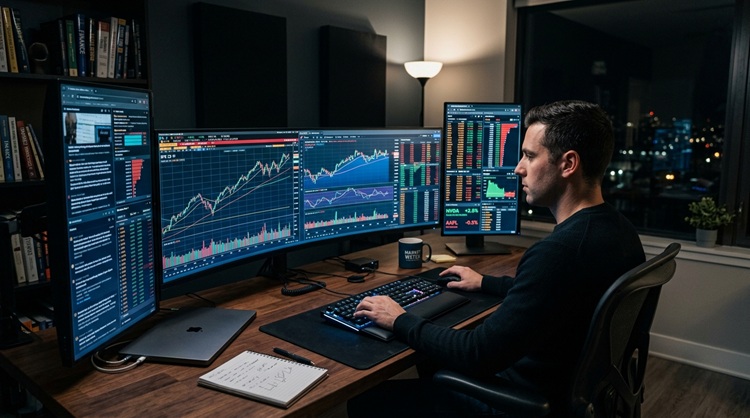
The phrase “passive income” has become one of the most effective marketing tools on the internet.
Scroll through enough videos or advertisements, and you’ll eventually find someone claiming that Forex allows them to make money while sleeping. A few screenshots, luxury cars, and a trading app running in the background make the idea feel believable. It creates the impression that once you learn a strategy, the money simply keeps arriving.
That picture leaves out the part that actually determines whether a trader survives.
The interesting thing is that experienced traders often appear to work less than beginners. They are not glued to charts all day, nor are they constantly placing trades. At first glance, it looks like they have achieved the dream of passive income. In reality, they have simply shifted their effort away from clicking buttons and toward preparation, research, and discipline.
Most of the Work Happens Before the Trade
A trader named Marcus used to begin every morning by opening five different charts and searching for something to trade.
If nothing looked promising after twenty minutes, he convinced himself that he simply had not looked hard enough. By lunchtime, he had usually opened three or four positions that never existed in his original trading plan.
After several frustrating months, he changed one habit.
Instead of asking, “What can I trade today?” he started asking, “Is today worth trading at all?”
Some days, the answer was no.
Ironically, his trading activity dropped by nearly half, yet his overall results improved because the quality of his decisions increased.
That hardly sounds passive. It sounds selective.
Markets Never Stay the Same
One reason passive income is difficult to apply to trading is that financial markets constantly evolve.
Economic releases change expectations. Central banks adjust interest rates. Political events shift investor sentiment. Even market volatility can look completely different from one month to the next.
According to the Bank for International Settlements, average daily turnover in the global foreign exchange market reached US$7.5 trillion in 2022, making it the largest financial market in the world.
That level of activity creates endless opportunity, but it also means traders compete in an environment that never truly stands still.
A strategy cannot simply be switched on and forgotten forever.
Automation Doesn’t Eliminate Responsibility
Many people assume automated trading systems solve this problem.
Sometimes they help.
They can execute trades faster, remove hesitation, and follow predefined rules without emotion.
What they cannot do is understand changing market conditions unless someone continues monitoring and improving the system.
Successful traders still spend time:
- Reviewing performance reports
- Updating risk parameters
- Watching major economic events
- Testing whether their strategy still matches current market conditions
The computer may execute the trade. The trader remains responsible for everything behind it.
The Goal Is Freedom, Not Passivity
Perhaps the biggest misconception is believing successful traders want passive income in the first place.
Many eventually stop chasing that idea.
Instead, they focus on building a process that demands fewer emotional decisions rather than less effort altogether.
That is an important difference.
Less stress does not necessarily mean less work.
The unexpected observation is that the more experienced someone becomes, the more comfortable they are with doing nothing. Sitting out an uncertain market can require far more discipline than placing another trade simply to feel productive.
In Forex, consistency rarely comes from finding a magical system that earns money unattended. It comes from developing routines that quietly improve decision-making long after the excitement has disappeared.
The screenshots often show the profits.
They rarely show the notebook filled with trade reviews, the weekends spent analysing mistakes, or the discipline required to close the platform without placing a single order.
That unseen work is usually where the real returns begin.